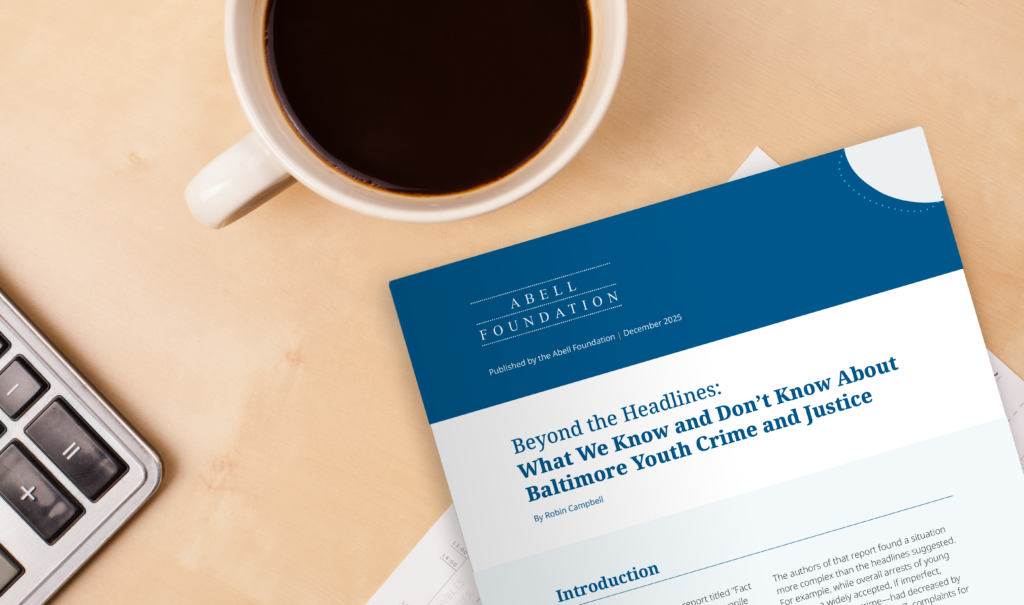
Even as Baltimore celebrates historic reductions in gun violence, local, state and even national media continue to broadcast headlines warning of crime by city youths ages 17 and younger, local leaders host high-profile events about youth crime, and state lawmakers propose tightening statutes pertaining to young people accused of breaking the law. At a similar moment of public concern seven years ago, the Abell Foundation report “Fact Check: A Survey of Available Data on Juvenile Crime in Baltimore City” documented a situation more complex than the headlines suggested. A new Abell report, “Beyond the Headlines: What We Know and Don’t Know About Baltimore Youth Crime and Justice,” found that the same is true today.
Like its predecessor, “Beyond the Headlines” poses basic questions:
- Is crime by children and youth up in Baltimore City?
- How are youth who are charged with crime handled by the criminal and juvenile justice systems?
- What happens in cases where young people are charged in adult court?
- What happens in cases where children are charged with violent crimes and transferred back into the youth justice system?
“Beyond the Headlines” analyzes data available from key entities engaged with crimes charged to young people—the Baltimore Police Department (BPD), the Maryland Department of Juvenile Services (DJS), the Governor’s Office of Crime Prevention and Policy (GOCPP), and, because many youths are charged in the adult criminal justice system and placed in adult facilities, the state’s Department of Public Safety and Correctional Services (DPSCS).
Key findings from this report include:
- Information about youth offending in Baltimore and systemic responses remain deeply siloed.
- Data from the Baltimore Police Department and the Department of Juvenile Services indicate that crime by Baltimore young people has continued a decades-long overall decline. However, short-term comparisons that take as a baseline the artificially low levels of juvenile crime during the COVID years obscure the overall positive trend.
- The fiscal years following the implementation of the Juvenile Justice Reform Act in 2022 have seen a smaller percentage of complaints from Baltimore City forwarded to the State’s Attorney’s Office compared to the fiscal years prior to the law’s implementation.
- A large and growing number of young people are being charged in the adult criminal justice system—many only to be redirected into the youth system once a judge has reviewed their cases.
- Gun possession charges are the leading reason youth in Baltimore, and statewide, are charged in adult criminal court.